In 2011, the Guinness World Records validated a puzzle of 551,232 pieces, assembled in Vietnam by 1,600 students. This record shattered previous standards, as most giant puzzles hardly exceeded 40,000 pieces.
The validation of such a record relies on strict criteria: each piece must fit perfectly, and the puzzle must be assembled in one go, without mistakes or replacements. Behind these numbers lie months of preparation, complex logistics, and meticulous organization. Records in this realm continue to be pushed, challenging patience and imagination.
Diving into the world of Guinness records: why puzzles are so fascinating
The Guinness World Records has continually documented feats that defy all expectations. Over the decades, the puzzle has established itself in the record book as a playground for enthusiasts, somewhere between personal achievement and collective adventure. As early as 1766, John Spilsbury imagined the very first known puzzle: a map of Europe, an educational tool for children. Since then, the discipline has taken on a borderless scope, driven by bold manufacturers like Ravensburger or Educa, as well as by anonymous individuals seeking to surpass themselves.
What is it that attracts so much in the pursuit of records? The puzzle is much more than just a pastime. It demands unwavering patience, flawless organization, and often, group strength. When 1,600 students from Ho Chi Minh City unite to assemble the largest puzzle in the world, 551,232 pieces to shape a giant lotus flower, the performance becomes collective. In Dubai, the area approaches the unreal with a mural of 6,122.68 m². In Barcelona, 9,569 people gather to take on the challenge together. These figures are not just records: they tell the story of the need to come together and share, to measure oneself against the impossible.
Beyond the spectacular, the diversity of categories recognized by the Guinness World Records is worth exploring. Here are a few examples that illustrate the variety of these feats:
- The puzzle with the smallest pieces ever produced (99 pieces measuring 6.5 x 5.5 cm)
- The largest personal collection (1,260 puzzles recorded)
- The speed of assembly or solving puzzles of formidable complexity (like the Eternity II)
Each record story, each detail, fuels a human adventure where individual success is part of the dynamics of a passionate group. The largest puzzle in the world is ultimately just one piece among others in the vast tableau of a universal enthusiasm for patience, skill, and cooperation.
What is the largest puzzle in the world? Numbers, anecdotes, and extraordinary feats
On September 24, 2011, in Ho Chi Minh City, an unparalleled feat marked the history of world records. The highlights of this performance are eloquent:
- 1,600 economics students gathered to assemble the largest puzzle in the world by number of pieces
- 551,232 pieces covering an area of 14.85 meters by 23.20 meters, creating a massive six-petal lotus flower
- 17 hours of collective effort, formidable logistics, a mural recorded in the Guinness World Records
For the largest area, Dubai takes the lead. The Dubai Multi Commodities Centre orchestrates a puzzle of 12,320 pieces, covering 6,122.68 m², the size of a sports field. These feats attest to the ability to combine precision, organization, and team spirit.
Among the remarkable performances, some figures are dizzying:
- At the Barcelona fair, 9,569 people simultaneously tackle a giant puzzle
- The largest hand-cut puzzle, created by Jill Walterbach: 101,010 pieces, 22 meters long, an abstraction painted in acrylic
- Khloud Abo Zayda, in St. Paul, Minnesota, holds the most impressive collection: 1,260 puzzles
On the commercial side, the giant is called “Travel Around the World”: 48,000 pieces, 28 kg, shipped in a suitcase. Proof that the passion for records also manifests in everyday life and catalogs around the world.
How a record becomes official: behind the scenes, criteria, and astonishing stories from the Guinness Book
The Guinness World Records does not merely list extraordinary feats. Behind each record, the procedure is meticulous and the verification constant. For a feat like the largest puzzle by number of pieces to make it into the record book, a complete file must be compiled: definition of the challenge, videos, photos, testimonies from bailiffs, precise measurements. The Guinness Book requires the presence of official witnesses and imposes strict rules to ensure that the record is reproducible. The idea is to guarantee universal recognition, without any possible ambiguity.
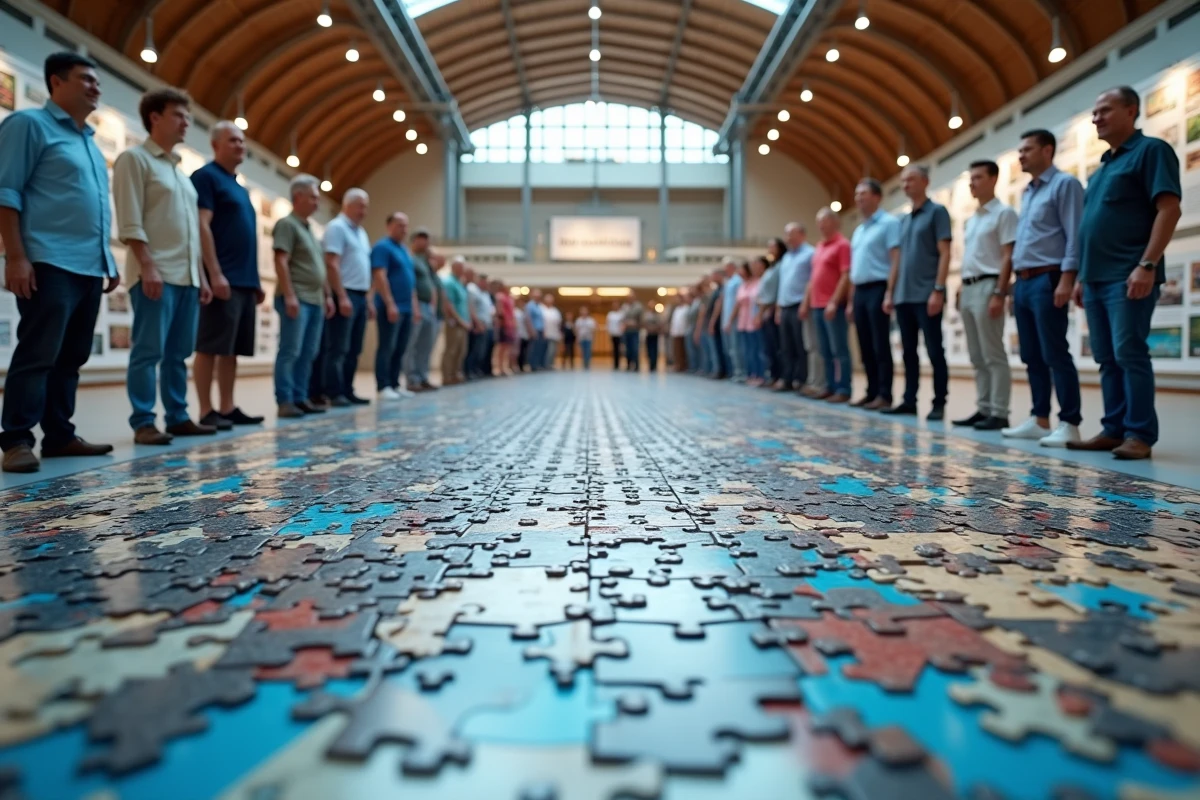
On the ground, the demand is tangible. During the giant puzzle in Ho Chi Minh City, each piece, each group of participants, each stage of assembly was meticulously recorded. The 1,600 students, spread over more than 340 m², followed a detailed specification to the letter. Images, measurement records, video broadcasts: everything was documented to allow the jury to examine the validity of the record.
The Guinness World Records does not only validate size or number of pieces. Other categories exist, such as the largest number of people gathered to assemble a puzzle during an event in Barcelona (9,569 participants) or the largest collection of puzzles recorded in Minnesota (1,260 puzzles). Some achievements, like the hand-cut puzzle by Jill Walterbach (101,010 pieces, 22 meters), require verification over several days, sometimes on-site.
This rigor makes the Guinness World Records a true reference. Whether it’s the smallest piece (0.361 cm² by Selegiochi) or the notoriously most difficult puzzle, the Eternity II, 256 pieces, rewarded with two million pounds, each record is part of a culture of accuracy, sharing, and passion. It’s hard to flip through the Guinness without imagining, for a moment, adding your own piece to this immense collective puzzle.