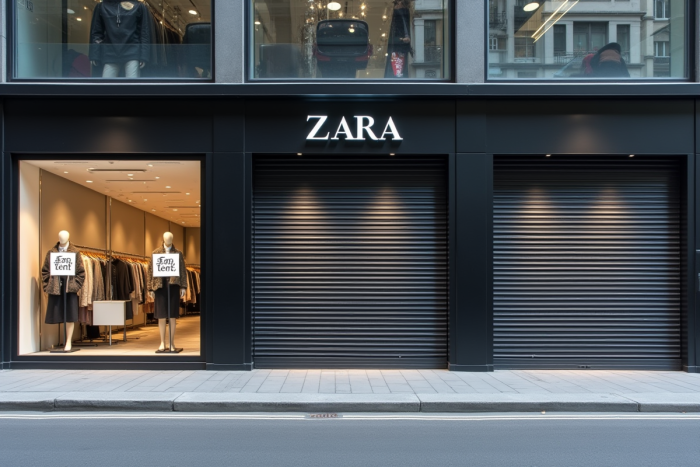
The closure of Zara, a pillar of the fashion retail industry, is disrupting the local economic landscape. Once-bustling shopping streets are emptying, directly affecting neighboring retailers who benefited from the influx of customers drawn to the brand. Restaurants, cafés, and other local businesses are also experiencing this decline in foot traffic.
Employees, for their part, find themselves unemployed, exacerbating unemployment and creating additional pressure on local social services. Suppliers and service providers for the brand are seeing their contracts vanish, causing a domino effect on the region’s economy.
The economic consequences of Zara’s closure on local businesses
The closure of Zara in France, particularly in cities like Saint-Nazaire, Angoulême, and Valence, is causing a real shockwave in the local economy. Neighboring stores, which benefited from the flow of consumers attracted by this flagship brand, are seeing their revenue plummet. This particularly affects independent retailers and small businesses.
Impact on employees and service providers
Employees of the closed Zara stores find themselves without jobs, worsening the local labor market situation. This precariousness also extends to service providers and suppliers for the brand, who are losing contracts essential to their economic survival. The Inditex group, owner of Zara, justifies these closures as part of a restructuring strategy aimed at modernizing and optimizing its store network, as seen in Nîmes where a new concept store has recently opened.
Reactions from local officials
David Samzun, mayor of Saint-Nazaire, expressed his disappointment and anger at this decision. He laments not only the loss of jobs but also the negative impact on the attractiveness and vitality of the city center. The successive closures of major brands like Zara and Bershka are fueling a spiral of commercial decline that is difficult to reverse.
Impact on other businesses
- Restaurants and cafés, which benefited from Zara’s clientele, are experiencing a drop in foot traffic.
- Other fashion boutiques, already struggling against online competition, are seeing their situation worsen.
- Shopping centers, deprived of a flagship store, are struggling to attract new tenants.
The closure of Zara in France illustrates a broader phenomenon of transformation in the fashion sector, where strategies of digitalization and streamlining often take precedence over local considerations.
The social and environmental repercussions of Zara’s closure
The repercussions of Zara’s closure extend beyond the local economy. They also affect social and environmental aspects. The fashion industry, particularly the fast fashion sector, is known for its controversial practices, often at the expense of workers and the environment.
Social consequences
The Zara brand, owned by the Inditex group, has been involved in scandals related to deplorable working conditions, notably during the collapse of Rana Plaza in Bangladesh in 2013. This tragic event highlighted the exploitative practices faced by workers in developing countries. Investigations conducted by NGOs like Public Eye continue to denounce precarious working conditions and miserable wages.
Environmental consequences
Environmentally, the closure of these stores could have mixed effects. On one hand, it could reduce greenhouse gas emissions associated with the mass and often disposable production of clothing. On the other hand, the demand for cheap clothing persists, and consumers may turn to other fast fashion brands with similar practices.
Legislation and initiatives
In response to these concerns, the National Assembly passed a law in March 2024 aimed at regulating the fast fashion sector. Christophe Béchu, Minister of Ecological Transition, stated that France is the first country to legislate so strictly on this issue. This legislation could encourage companies to adopt more responsible practices, both socially and environmentally.
The actions of engaged figures like Raphaël Glucksmann, who fights against the exploitation of Uyghurs in China, and analyses by experts like Audrey Millet, highlighting chemical dangers in clothing, contribute to raising public awareness and putting pressure on major brands for sustainable change.