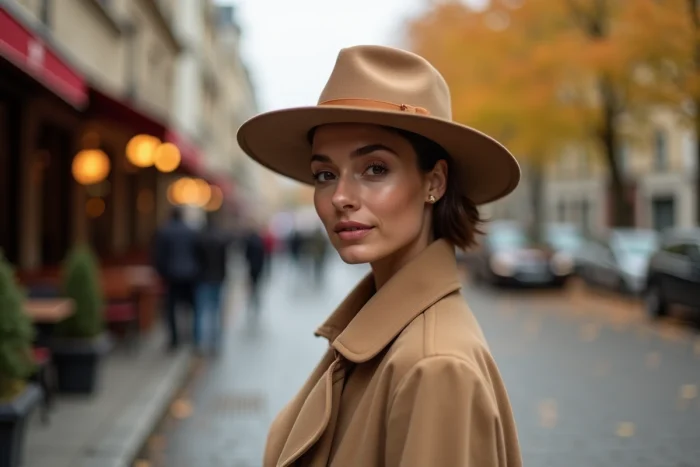
Women who adopt hats quickly notice: this accessory changes posture even before it alters style. This link between headwear and body attitude largely explains why hats remain a staple of the women’s wardrobe, well beyond trend cycles.
Hat and self-confidence: what the post-pandemic professional context has changed
Since the rise of hybrid work, dress codes have become blurred. In video conferences, only the upper body is visible. For some women, the hat has become a visual framing tool: it structures the face on screen and sends a signal of intent.
Have you ever noticed that some people seem more assertive as soon as they wear a distinctive accessory? It’s not a coincidence. A clothing item that draws attention to the face focuses the interlocutor’s gaze. In a hybrid meeting context (part in-person, part remote), the hat focuses attention on the upper face and the eyes.
This phenomenon goes beyond mere vanity. During in-person days, the hat acts as a marker of physical presence, a reminder that the person has made a deliberate clothing choice. This intentional gesture, even if subtle (a simple fedora, a structured beret), is enough to alter how others perceive you and how you perceive yourself.
As detailed in the article from La Mode Urbaine, the reasons women wear hats blend personal affirmation and pragmatism, a balance that the current professional context has made more visible.

Cultural significance of the women’s hat: from social symbol to feminist gesture
The women’s hat has never been neutral. It has long served to signal social rank, religious affiliation, marital status. What has changed is the direction of the message: today, the hat speaks more about the woman wearing it than the group to which she belongs.
The Catrina and feminist streetwear
A striking example comes from Mexico. During Día de Muertos 2025, influencers reinterpreted La Catrina, the skeletal character adorned with a large floral hat, in a streetwear version. La Catrina has become a feminist symbol of social subversion, repurposed to assert empowerment against patriarchal norms.
In this case, the hat is no longer a decorative accessory. It carries a political message.
Cultural fusion in the Asia-Pacific
On the other side of the world, a different trend is emerging. Since 2025, women in the Asia-Pacific have been incorporating fedoras inspired by the bollenhut (a traditional hat from Germany’s Black Forest) into hybrid looks that blend traditional and modern elements. This niche of cultural fusion creates a market absent from Western circuits.
These two examples show that the women’s hat functions as a cultural vehicle, capable of conveying very different messages depending on the geographical context.
Women’s hat trends: which styles are in this season
Why do some styles return every year while others disappear? The answer often lies in their versatility. A hat that only works in one context (beach, ceremony, festival) has a limited lifespan in a wardrobe. The styles that transcend seasons share a few characteristics:
- The bucket hat, revived by streetwear, works equally well in the city and by the sea. Its flexible shape adapts to both casual outfits and more polished looks.
- The medium-brim fedora remains a classic for mid-seasons. Its rigid structure gives an immediate flair, even with just a pair of jeans and a blazer.
- The beret, a timeless piece of French fashion, oscillates between cultural heritage and everyday accessory. It fits easily into a bag and can be worn without preparation.
- The wide-brimmed hat, more spectacular, retains its place at formal events (weddings, horse races) but also finds an audience for more casual use, worn with flowing outfits in summer.
The current trend favors natural materials (braided straw, wool felt, cotton) and shapes that do not restrict movement. Comfort and lightness remain the best indicators of a suitable model.
Fashion and hat accessory: how to choose according to your morphology
Are you hesitating in front of a display? The shape of the face remains the most reliable criterion to avoid mistakes.
- A round face benefits from being visually elongated: high-crowned hats (fedora, soft top hat) create this illusion.
- An elongated face is balanced with wide brims, such as a wide-brimmed hat or a bucket hat with a drooping brim, which widen the horizontal line.
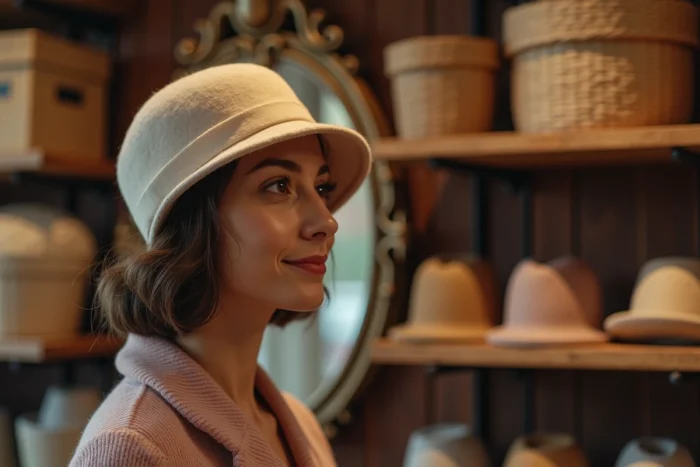
- An angular face (defined jaw, prominent cheekbones) is softened with rounded shapes: beret, cloche, soft bucket hat.
The simplest test is done in front of a mirror, at arm’s length, checking that the hat does not obscure the face and leaves the eyes visible. If your eyes disappear under the brim, the size or shape is not right.
Comfort is as important as aesthetics. A hat that is too tight causes headaches. A hat that is too loose flies away at the first gust of wind. Taking the time to try on and adjust the fit remains the safest method to find the model that will become a reflex rather than a constraint.
The women’s hat today occupies a space that few accessories can claim: both practical (sun protection, warmth), expressive (culture, identity, message), and transformative (posture, confidence, presence). Its longevity in the fashion world is due to this triple function, which withstands the effects of trends because it meets real needs.