Genealogy is not just about filling in boxes on a tree. It is an investigative work that requires skills in paleography, ancient law, and cross-source analysis. Tracing one’s ancestors involves mastering the logic of archival collections, understanding documentary gaps, and knowing how to utilize DNA matches when records are lacking.
Paleography and parish registers: the first technical hurdle
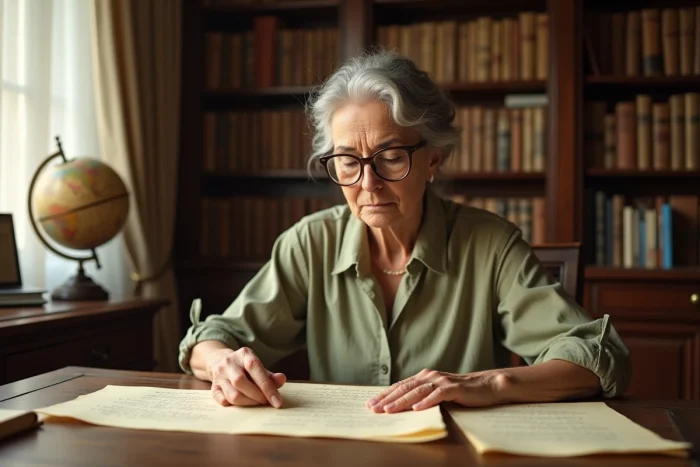
Before the French Revolution, civil status did not exist in its current form. Parish registers, maintained by the clergy, are the primary source for going back beyond the 18th century. Reading them requires familiarity with ancient scripts, Latin abbreviations, and notarial formulations from the Ancien Régime.
We regularly observe that researchers get stuck on a branch not due to a lack of documents, but because they cannot decipher a record. Paleography remains the most discriminating skill in genealogy. A long “S” confused with an “f”, a misinterpreted ligature, and the identification of a surname can derail research across several generations.
Departmental archives have digitized a significant portion of their collections, available for free online. Specialists like those found at jeanlouis-garret.fr offer support for the transcription and translation of ancient documents, particularly notarial acts predating the 17th century.
Beyond BMS (baptisms, marriages, burials), inventories after death are an underutilized source. These notarial documents describe a deceased person’s assets piece by piece, sometimes mentioning debts, credits, and family ties absent from parish registers.
Hybrid method: combining departmental archives and genealogical DNA
Genealogical research has changed in nature in recent years. The classic documentary approach (civil status, parish registers, censuses) now combines with genetic analysis to unlock branches that cannot be traced through documents alone.
DNA does not replace archives; it fills their gaps. A genetic result without documentary context remains raw data, unusable for constructing a lineage. However, when a record is missing (destroyed register, gap period), DNA matches allow for hypotheses to be formulated, which are then compared to available sources.
In France, genealogical DNA tests are not permitted on the territory. Samples are sent abroad, raising questions about data protection and the reliability of matching databases. We recommend treating results as one clue among others, never as isolated proof.
The concrete limits of genetic matches
An autosomal DNA test detects matches with individuals sharing a common ancestor. The difficulty lies in attribution: a match can go back several generations, and without a documented tree on the match’s side, the information remains vague.
- Databases from platforms like MyHeritage, Filae, or Geneanet have very variable panel sizes depending on geographical regions, which skews the representativeness of results
- Mitochondrial DNA (maternal line) and Y chromosome (paternal line) cover only one line of descent out of hundreds possible to the tenth generation
- DNA matches between distant cousins require triangulation work, meaning comparing shared segments among several matches to locate the common ancestor
Reconstructing dispersed branches: notarial sources and specialized collections
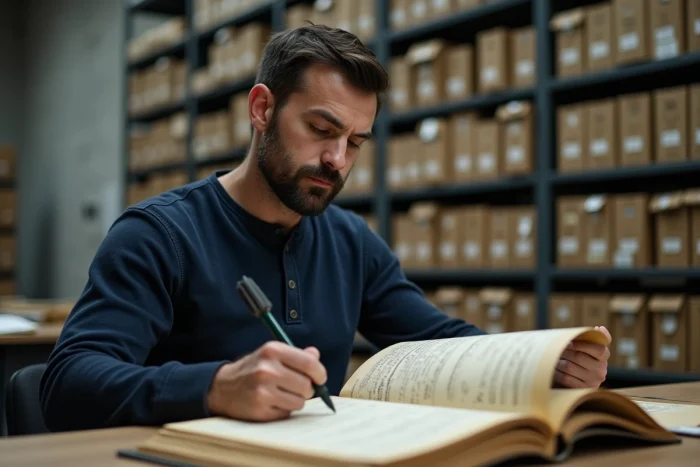
Notarial acts are the backbone of any in-depth research. Marriage contracts, wills, inheritance shares, farm leases: these documents reveal family ties, migrations, and alliances that civil status alone does not mention.
Notarial minute books are kept in departmental archives, sometimes in national archives for Parisian studies. Their indexing remains partial, and research often requires sifting through entire bundles to locate a relevant act.
Military registers and sources
Military matriculation registers, mostly available online for most departments, provide valuable supplementary information. Each record contains the place of birth, profession, physical description, and sometimes mentions of military campaigns. For male ancestors born after 1867, the matriculation register often provides the last known residence and family composition.
Legion of Honor files, passenger lists for overseas migrations, and hospital archives complete the picture. Each of these sources covers a blind spot of the classic registers.
Genealogical journey: connecting archives to places of origin
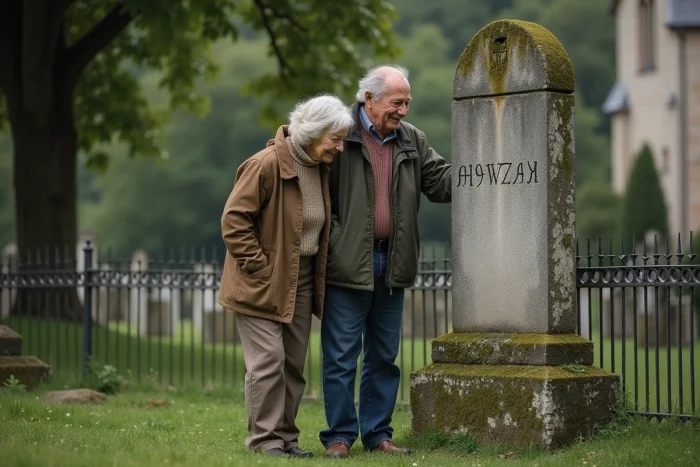
A research axis that is still poorly structured involves associating the documentary approach with the physical discovery of places. Finding the church where an ancestor was baptized, identifying the farm mentioned in a notarial lease, walking through a communal cemetery to cross-check dates: the field provides elements that digital archives do not capture.
Rural town halls sometimes keep registers or deliberations that are not digitized. A visit allows access to these collections, as well as gathering oral history from residents who still carry the sought surnames.
- Napoleonic cadastres, available in departmental archives, allow for locating a family property on a specific plot in the early 19th century
- Old aerial photographs from the IGN help identify disappeared buildings mentioned in the acts
- Local genealogical associations often maintain systematic records of a canton, indexed by surname, which significantly speeds up locating
Genealogy gains rigor when it articulates three levels of evidence: the written document, genetic data, and field observation. Neglecting any of these levers is to accept areas of uncertainty that the missing source could have clarified.