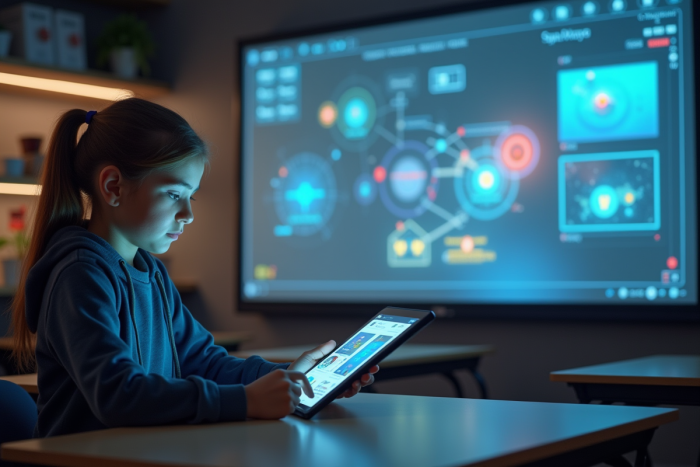
With the rise of digital technologies, education is undergoing an unprecedented transformation. Online platforms provide flexibility and access to educational resources that were once unimaginable. Students can now learn at their own pace, explore subjects of personal interest, and benefit from more interactive and engaging teaching methods.
Teachers also find advantages in this digital revolution. Online tools allow for the personalization of learning paths, real-time tracking of student progress, and more effective collaboration with colleagues. This educational adaptation opens new perspectives for a more inclusive and dynamic education.
Online platforms: a lever for accessible and flexible education
Digital platforms are profoundly changing teaching practices. Take YouTube, for example, which hosts a variety of digital content accessible to all. This platform allows teachers to supplement their lessons with educational videos, thus enriching the learning experience for students.
MOOCs (Massive Open Online Courses) are also valuable tools. These digital courses enable thousands of learners to access quality training, often provided by prestigious universities. They offer unprecedented flexibility, allowing students to take courses at their own pace and according to their availability.
Another platform to consider is Mycampus Eduservice, which offers a comprehensive integration of digital tools for educational institutions. This platform not only manages online courses but also tracks student progress and facilitates communication between teachers and learners.
The diversity of available digital tools, such as the ESG extranet, provides a multitude of features for students and teachers. This type of platform facilitates access to educational resources, simplifies administrative management, and improves collaboration among various education stakeholders.
- Flexible access to educational resources
- Personalized tracking of student progress
- Improved communication between teachers and learners
These innovations are not limited to the tools mentioned. Digital technology allows for increased personalization of educational pathways, making education more inclusive and adaptable to the needs of each student. 
Challenges and perspectives of digital integration in schools
The integration of digital technology in education presents several challenges. Gérard Giraudon, a digital expert, emphasizes that teacher training remains a priority. Without adequate mastery of digital tools, teachers will not be able to fully exploit the potential of these technologies.
Margarida Romero, also a digital expert, highlights the need to develop specific skills among students. Mastery of digital tools should not be limited to their technical use but should also include a critical understanding of their implications.
| Technology | Example |
|---|---|
| Augmented reality | Interactive applications in class |
| Virtual reality | Immersive simulations for learning |
| Educational robotics | Programming and robotics workshops |
| Machine learning | Data analysis to personalize teaching |
Derek Muller, founder of Veritasium, often demystifies misconceptions about digital technology. His analyses show that technologies do not replace the teacher but assist them in their tasks, enriching the educational experience.
André Tricot analyzes the role of digital technologies in education, highlighting their impact on traditional teaching methods. Augmented reality and virtual reality open new horizons for immersive learning, while educational robotics and machine learning allow for the personalization of teaching.
Sylvie Blanco and Thierry Picq from GEM integrate these technologies into their training, proving that higher education can benefit from these innovations. Paris 1 Panthéon-Sorbonne, under the leadership of Bruno Dondero, also adopts these tools to modernize its law courses.
These perspectives show that the path to successful digital integration in schools is still long but promising. The challenges are numerous, but the opportunities offered by these new technologies are considerable.