In an industrial estate car park or coming out of a tight bend, you can quickly tell the difference between a supermoto built for cruising and one designed for hard riding. Choosing a supermoto dirt bike is about more than engine size or the logo on the tank. Several technical factors, often overlooked in listings, determine whether a bike is genuinely suited to your everyday needs.
Roadworthiness tests and an A2 licence: two checks to make before comparing anything
Before looking at engine specs, start by checking two administrative requirements that can rule out half the listings. Since 15 April 2024, motorcycles have been subject to periodic roadworthiness testing. Models first registered in 2020 and 2021 are among those affected in 2026. Check the test date and result before buying to avoid an unpleasant surprise when registering the bike.
Be careful with enduro bikes converted to supermotos: the roadworthiness test exemption applies only to enduro and trial bikes used for sport, provided the owner can show an annual licence from the French Motorcycling Federation. A dirt bike converted to 17-inch wheels for road use is not automatically exempt.
If you ride on an A2 licence, the rules set a maximum power output of 35 kW and a maximum power-to-weight ratio of 0.2 kW/kg. A more powerful motorcycle can be restricted for A2 use only if its original power does not exceed 70 kW. Checking a supermoto dirt bike comparison makes it easy to filter for models that match your licence and budget.
Weight, seat height and chassis geometry: what really changes the way a bike rides
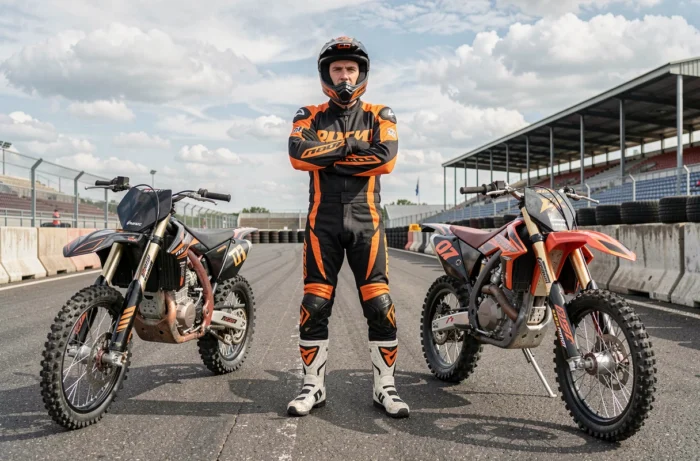
Manufacturers highlight power in large print and weight in small print. On a supermoto, dry weight affects agility in town and how easily you can pull wheelies. You’ll feel a difference of just a few kilograms between two models with the same engine size from the very first U-turn in a car park.
Seat height is another factor beginners tend to underestimate. Most supermotos have a tall seat, inherited from their motocross or enduro roots. Models derived from off-road bikes (KTM, Husqvarna, GasGas) are often too tall for many riders. For an average-height rider, being able to put one foot flat on the ground makes a real difference to confidence at traffic lights and during low-speed manoeuvres.
Geometry and suspension travel
A road-focused supermoto has shorter, firmer suspension than an enduro. Reduced suspension travel lowers the centre of gravity and improves cornering on tarmac. If you’re buying a converted enduro, check that the suspension has been recalibrated for road use, rather than simply shortened with spacers.
Wheel diameter is also part of the equation. Genuine 17-inch wheels let you fit road-sport tyres, with a wide choice of compounds. 21/18-inch wheels with dual-purpose tyres are a sign of an incomplete conversion and limit grip on asphalt.
Engine and torque: choose based on how you’ll ride, not the spec sheet
The classic mistake is to compare maximum power alone. On a supermoto, low- and mid-range torque has a much greater effect on the bike’s character than top-end power. A large-displacement single (such as a 690 or 701) delivers strong torque from low revs, making it ideal for pulling away out of roundabouts or accelerating around town.
Singles derived from motocross engines (such as 450-based models) rev higher and need to be worked harder to make the most of their potential. They also require more frequent maintenance, including shorter oil-change intervals and more frequent valve checks. An engine designed for road use handles daily mileage better than a road-legal motocross engine.
- Large-displacement single (500-700 cm3): plenty of torque, longer maintenance intervals, suited to a mix of road riding and leisure rides.
- Mid-displacement single (250-450 cm3): lighter, livelier at high revs, more frequent maintenance, built for spirited riding.
- Twin (rare in a pure supermoto): smoother running, heavier, more road-oriented than sporty.

The real cost of a supermoto dirt bike: purchase price and hidden expenses
The list price only tells part of the story. On a supermoto, wear parts go quickly: brake pads, rear tyres, chain and sprockets. Motocross-based models wear through these consumables faster than a conventional roadster because their brakes and drivetrain are put under greater strain.
Annual wear-part costs can make up a significant share of your budget, especially for smaller-displacement bikes that seem affordable to buy. Before signing, check the prices of the following parts with your dealer:
- Complete chain kit (chain, front sprocket, rear sprocket): prices vary considerably by make and model.
- Front and rear brake pads: they need replacing more often than you might think in urban use.
- 17-inch road-sport rear tyre: soft compounds wear quickly if you enjoy leaning into corners.
- Engine oil and filter change: on a motocross-based single, the interval can be two to three times shorter than on a road-focused engine.
Used bikes and what to look out for
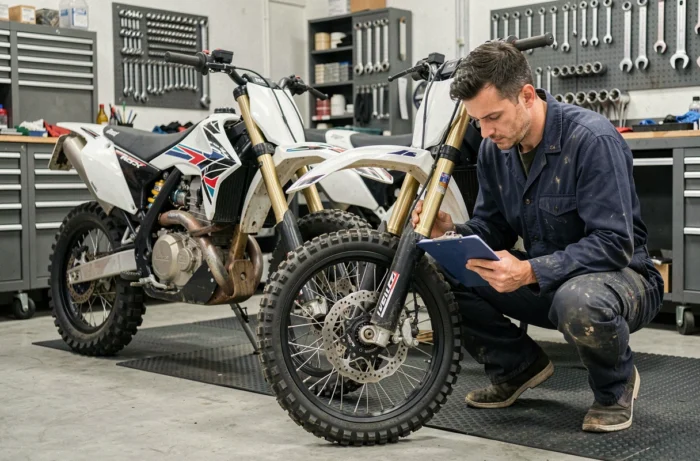
On the used market, a supermoto with low mileage isn’t necessarily in good condition. These bikes are subjected to high mechanical stresses (wheelies, hard braking, low-speed drops). Inspect the handlebar clamps, lever ends and frame around the engine mounts. Scuff marks on the engine cases or frame point to a fall, even if the odometer shows low mileage.
Choosing a supermoto dirt bike comes down to practical details: legal compliance, geometry suited to your build, an engine type that matches how you’ll actually ride, and an annual maintenance budget. Comparing models on these criteria rather than on headline power alone is the surest way to avoid regrets after a few months on the road.