Terrestrial biodiversity includes several million described species, yet only a handful capture the public’s attention for their extraordinary abilities. Behind the legitimate fascination for these surprising animals lie often underestimated scientific and ecological issues: genomics applied to biomedicine, cultural transmission between generations, and the explosion of illegal trafficking. This article presents the facts about a few emblematic species and the questions they raise.
Tardigrades and Pufferfish: Model Animals for Biotechnology
Popular articles readily present the tardigrade as an “indestructible” animal capable of surviving in the vacuum of space. What receives less attention is the concrete exploitation of this resistance by biomedical research.
Since 2022, comparative genomics studies, including the work of Yoshida et al. published in PLOS Biology in 2023, have used the tardigrade and pufferfish as models to understand resistance to radiation and desiccation. The goal exceeds mere naturalistic curiosity: these organisms could provide insights for the conservation of biological tissues or cellular protection in a medical context.
Specialized resources like univers-animaux.net allow exploration of the diversity of these species and the characteristics that make them so useful to science. The pufferfish, for example, has one of the most compact genomes among vertebrates, making it a reference tool for comparative genomics.
The available data do not yet allow for measuring the actual therapeutic potential of these discoveries. However, the shift from “curiosity” status to “biomedical model” profoundly changes how the scientific community approaches these species.
Animal Culture: When Octopuses and Crows Transmit Knowledge
The boundary between instinct and culture in non-human animals has been the subject of scientific debate for several decades. Recent work in behavioral ecology brings new insights.
Several species known for their individual capabilities, such as the octopus, the crow, or certain cleaner fish, develop distinct local cultures that are transmissible between generations. This observation, long reserved for primates and cetaceans, now extends to more distantly related taxonomic groups.
Wildlife and Social Learning Beyond Mammals
In New Caledonian crows, tool-making varies from one population to another, with regional “styles” transmitted through observation. This phenomenon meets the strict definition of culture used in primatology.
Octopuses, although they do not live in stable social groups, exhibit observational learning behaviors in the laboratory. Field reports diverge on this point: the transposition of these results to natural settings remains debated.
- The New Caledonian crow adapts the shape of its tools according to local resources, knowledge passed between adults and juveniles.
- Some cleaner fish adjust their behavior based on the “clientele” present, a form of learned social strategy.
- Populations of bottlenose dolphins use marine sponges as protection while foraging, a behavior absent in other populations of the same species.
These observations raise an open question: how many species possess forms of culture that science has not yet identified, due to a lack of long-term behavioral studies?
Axolotl, Quokka, and Threatened Biodiversity: The Hidden Face of Fascination
The popularity of certain species on social media has direct consequences for their survival. The case of the axolotl is the most documented.
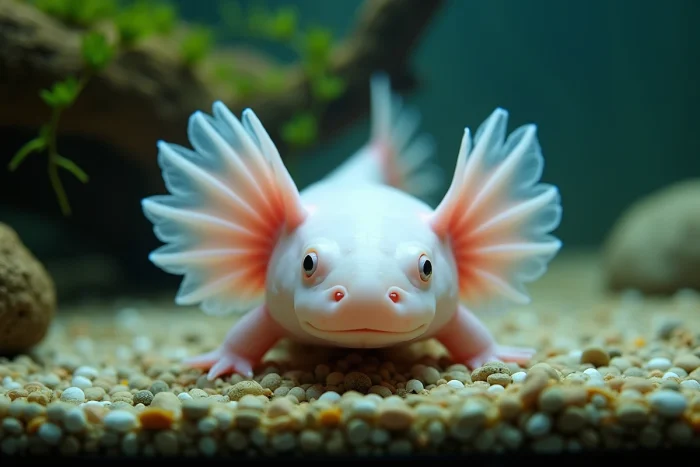
The axolotl was listed as “critically endangered” on the IUCN Red List in 2020. This Mexican amphibian, famous for its regenerative ability, faces increasing pressure from illegal trafficking for the exotic pet market and aquarium trade. Customs seizures of live specimens have significantly increased in Mexico and the United States since 2021.
A Phenomenon Affecting Other Spectacular Species
The axolotl is not an isolated case. Since 2021, several species highlighted in popular content have experienced an explosion of illegal trafficking: seahorses, platypuses, sloths. The pangolin, already threatened by the trade of its scales, sees its situation worsen with the demand for it as an exotic animal.
The Amazon river dolphin, classified as endangered by the IUCN, illustrates another facet of the problem. Its pink hue, linked to scar tissue resulting from male confrontations, makes it a highly shared photographic subject. Habitat fragmentation and fishing continue to reduce its populations.
Observation and Ecological Role: What Fascination Should Include
Most content about fascinating animals stops at anecdote. The ecological role of these species in their respective habitats is rarely addressed.
The quokka, a small Australian marsupial that has become a social media icon for its “smiling” expression, plays a role in seed dispersal within the forests and coastal areas of southwestern Australia. Its population, concentrated on a few islands and restricted continental areas, directly depends on the quality of its habitat.
- Cleaner birds participate in controlling parasites on large mammals, a measurable ecological service.
- Fruit bats ensure the pollination of many tropical plant species.
- “Spectacular” predators like the snow leopard regulate ungulate populations, maintaining the balance of mountain ecosystems.
Each fascinating species occupies a specific function in its ecosystem, and the disappearance of one can trigger cascading effects that are often difficult to anticipate. Wildlife observation, whether practiced in natural settings or documented through research, benefits from integrating this functional dimension rather than focusing solely on the aesthetic aspect.
Genomics, behavioral ecology, and the fight against species trafficking converge on the same conclusion: the most surprising animals in the world are not just subjects of entertainment. Their study and protection condition scientific advancements and the maintenance of biodiversity on a global scale.