Child development cannot be managed like a school program. Motor, language, and emotional skills progress in irregular stages, with periods of stagnation that do not necessarily indicate a delay. We regularly observe that families overestimate certain milestones (walking, first words) while underestimating less visible skills, such as emotional regulation or the ability to maintain attention on an unstructured task.
Symbolic play and mental health: an underutilized link by parents
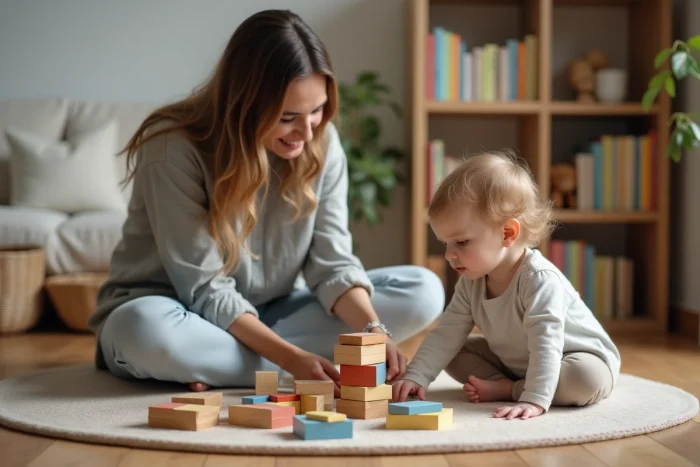
The act of “pretend play” is not just simple entertainment. Research shared by Pourquoidocteur shows that children who engage more in symbolic play exhibit fewer emotional and behavioral issues in primary school. This finding repositions play kitchens, figurines, and invented scenarios as tools for prevention, not just stimulation.
The adult’s role during these sessions makes all the difference. We recommend commenting on what the child is doing rather than directing the scenario. Systematically correcting an invented story or imposing a logical sequence breaks the very mechanism that makes this play beneficial. The adult mirrors the child’s actions without taking narrative control.
In practical terms, this means verbalizing observations (“you are feeding the teddy bear”) instead of asking closed questions (“what is this dish?”). This type of interaction supports language development while preserving the child’s initiative. Parents who wish to access the child section of Allo Papa will find additional resources on this daily support.

Screens before age 3: recommendations are stricter than one might think
No screen exposure is recommended before age 3, including background noise. Having the television on in the room during meals or free play fragments the toddler’s attention and reduces the amount of verbal interactions between the adult and the child.
Between ages 3 and 6, screen use should remain exceptional, supervised, and limited to quality content. In practice, “supervised” means that the adult watches with the child, rephrases what is happening on screen, and ends the session after a short, pre-defined time.
A common pitfall: using screens as emotional regulators. A child who cries and is calmed with a tablet does not learn to manage frustration. They associate soothing with a passive external stimulus. Replacing the screen with a simple sensory activity (playdough, water play, sorting objects) requires more immediate energy but builds lasting regulation skills.
Sleep and environment: two variables that condition everything else
A child who sleeps poorly learns poorly. Sleep quality directly influences the consolidation of language and motor skills learned during the day. We observe that families invest in stimulation activities without having stabilized bedtime rituals.
Concrete levers for a sleep-friendly environment:
- Maintain regular bedtime schedules, including on weekends, with a limited maximum gap to avoid disrupting the circadian rhythm
- Reduce brightness and sound stimulation at least thirty minutes before bedtime
- Remove all screens from the bedroom, regardless of the child’s age
- Offer a short and predictable ritual (story, song, same sequence every night) that signals to the brain the transition to rest
The physical environment plays a comparable role during the day. A space cluttered with toys saturates attention. Fewer visible toys, more time on each object: this principle promotes concentration and creativity. Rotating available toys weekly helps maintain interest without multiplying purchases.

Language development: what daily interactions really build
A language-rich environment is not just about talking a lot in the child’s presence. The quality of exchanges takes precedence over quantity. A turn-taking dialogue, even with a babbling baby, structures the foundations of communication well before the first words appear.
Three high-impact practices for language skills:
- Name objects and actions as the child looks at or manipulates them, to anchor vocabulary in direct sensory experience
- Allow a moment of silence after a question to enable the child to formulate a response, even if non-verbal
- Read stories while pointing to the images and accepting that the child turns the pages out of order, as handling the book is part of the learning process
Parents who narrate everyday actions (“I am cutting the apple, you see the red skin”) provide contextualized language input that is far more effective than formal vocabulary exercises. This type of interaction can be integrated into meal preparation, bath time, or dressing without requiring dedicated time.
Beware of comparisons between children
Each child develops their skills according to their own timeline. A language delay at two years does not predict a lasting disorder, just as a motor advance does not guarantee an overall cognitive advance. Regular observation by parents and early childhood professionals remains the best detection tool, far ahead of standardized checklists consulted online.
The signals that justify a specialized consultation are more about the trajectory (prolonged stagnation, loss of acquired skills) than the absolute level at a given age. A child who progresses slowly but steadily generally follows their own neurological maturation pace.